
Can Your Skincare Routine Cause Acne? What Studies Say About Washing, Products, and Hair Care
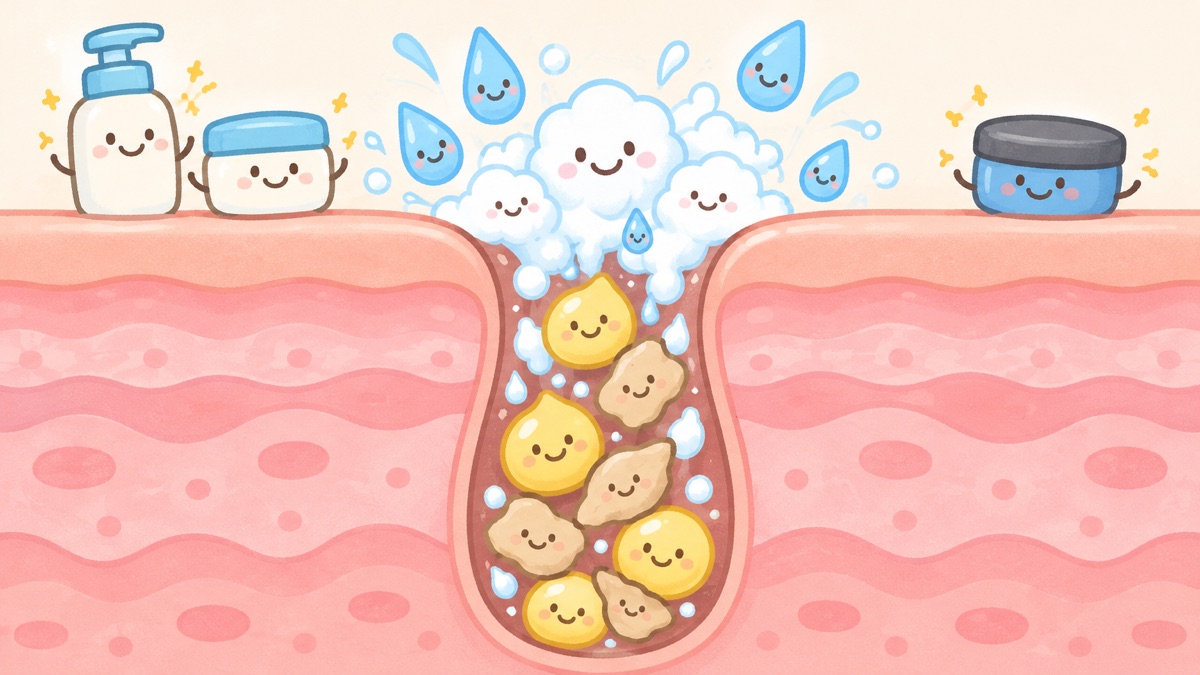
You wash your face twice a day, maybe three times when a breakout shows up. You layer a toner, a serum, a moisturizer, sunscreen. Then you style your hair and head out. Every step feels like taking care of your skin. So it's fair to ask: can your skincare routine cause acne?
The short answer is that the research is thin, but a few habits keep showing up next to worse breakouts. Here's what the studies actually found.
Think of a pore as a tiny drain
Your pores are like small drains. Oil and dead skin cells flow up and out of them all day. Washing your face is how you keep the drain opening clear.
Skip cleaning, and the drain clogs. But you can also clog it by scrubbing too hard, pouring too much down it, or letting grease drip in from somewhere else. Each of those maps onto one habit.
Washing more doesn't mean clearer skin
When acne flares, the instinct is to wash more. One randomized trial tested this directly. Men were assigned to wash once, twice, or four times a day. There was no significant difference between the three groups (Choi 2006). Only the twice-a-day group saw fewer comedones, the small clogged bumps that come before red pimples.
Cleaning a drain four times a day doesn't make it four times cleaner. And scrubbing hard can scratch the pipe. Skin that gets rubbed a lot builds up a thicker layer of dead cells to protect itself. That's how calluses form on your hands. Daily scrubs and peels may add to the very buildup you're trying to clear.
Water temperature may matter too. Korea's Disease Control and Prevention Agency notes that sebum output rises about 10% for every 1°C increase in body temperature. Long, hot water on your face could push more oil toward the drain. Lukewarm water does the job.
Too many products, too many layers
The second habit is what you put on after washing. A Korean survey of 539 people with acne found that among those whose acne hadn't responded to medication, 38% said cosmetics had made it worse (Suh 2021). That group also tended to double cleanse and use more products.
Picture pouring something new down the drain every morning and night. Toner, serum, cream, sunscreen, foundation, then cleansing oil to take it all off. Each one might be gentle on its own. Stacked up, some of it stays behind at the opening.
Keep in mind this was a survey. It can't prove cosmetics caused anyone's acne. What it shows is that more products and double cleansing were linked with people reporting worse skin.
Grease dripping down from upstairs
The third habit doesn't start on your face at all. Hair wax, pomade, and hair oil travel. Sweat, pillowcases, and bangs carry them down to your forehead and hairline. It's grease from upstairs clogging the drain below.
Dermatologists have described "pomade acne" for decades. One study had people use non-comedogenic hair care products for 8 weeks (Rubin 2021). It had no comparison group, though, so it can't tell us much on its own. Still, if your breakouts sit mostly along your forehead and hairline, your hair products are worth a look.
How strong is the evidence?
Honestly, not very. Over-washing, product count and double cleansing, and hair products all land in the weak evidence tier. There are few large randomized trials. Most of what we have comes from surveys and small studies.
So nobody can promise that cutting a step will clear your skin. But this area has one big advantage over genes or hormones. You can change it tomorrow morning.
Here's a simple four-week experiment:
- Wash twice a day, with lukewarm water.
- Pause scrubs and peels.
- Drop down to the products you actually need.
- Keep hair products off your forehead, and pin back bangs if they rest on your skin.
If things shift, you've found a clue. If nothing changes, that's a clue too. It means your drain may be clogging for a different reason.
Washing and products are only one of seven areas linked with acne. Diet, sleep, stress, hormones, medications, and your environment can all play a bigger part. If your acne got worse suddenly or you have many deep, painful nodules, it's a good idea to talk with a dermatologist.
If you want to see whether your routine or something else is the bigger factor for you, Angry Puku's Acne Cause Report compares all seven areas based on your own habits in about 10 minutes.
References
- Choi 2006, A single-blinded, randomized, controlled clinical trial evaluating the effect of face washing on acne vulgaris, Pediatric Dermatology
- Suh 2021, Relationship between acne and the use of cosmetics: Results of a questionnaire study in 539 Korean individuals, Journal of Cosmetic Dermatology
- Rubin 2021, Efficacy of a Non-Comedogenic Hair Care Regimen for the Reduction of Mild-to-Moderate Truncal and Facial Acne: A Single-Arm 8-Week Study, Journal of Drugs in Dermatology
- Korea Disease Control and Prevention Agency, acne information page